Hastingleigh.com A Genealogy Website /One Place Study contact e-mail
Those Magnificent Men in their Flying Machines: 1923
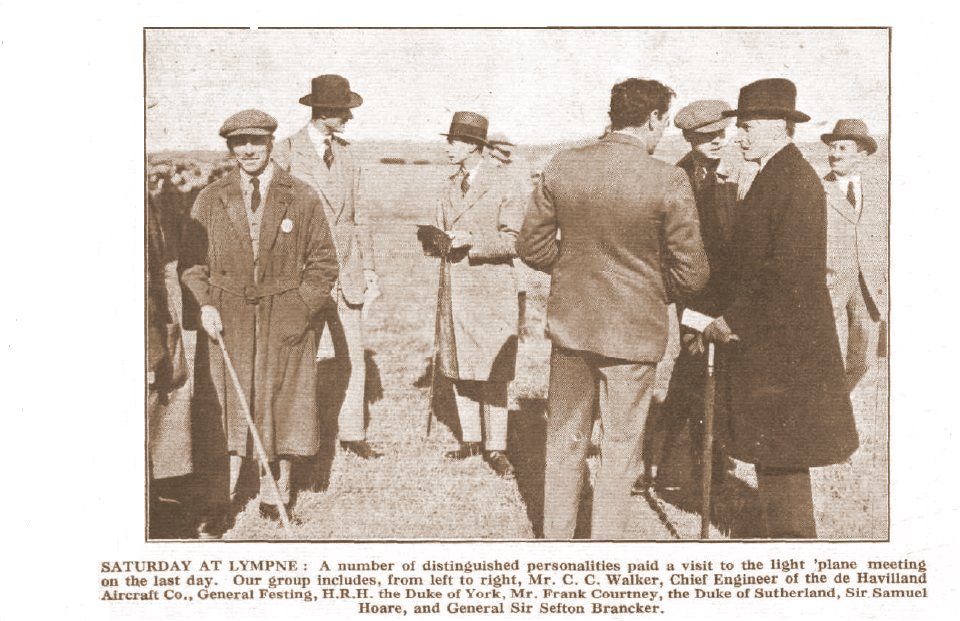
In October 1923 the first aviation race meeting for light aircraft (1 seater planes) was organised by the RAeC (Royal Aero Club) at Lympne Airfield, under the Chairmanship of the Duke of Sutherland and in conjunction with sponsorship by the Daily Mail Newspaper. There was a lot of prize money at stake, Sutherland had offered 500 pouns, and the Daily Mail offered 1000 pounds, for the greatest distance covered on 1 gallon of fuel.
(The Sutherland prize was for British Pilots in British machines only, and the Daily Mail prize for any nationality.)
The Abdulla prize was 500 pounds for the fasted speed round two laps of the course. Open to anyone.
Sir Charles Wakefield offered a 200 pounds prize for attaining the greatest altitude. Open to anyone.
The society of Motor Manufacturers and Traders offered a prize for the greatest number of laps of the circuit over the course of the meeting.
This prize fund was matched by The British Cycle and Motorcycle Manufacturers and Traders Union.
The circuit to be flown was from Lympne airfield, over to Postling then up along the southern edge of the North Downs to South Hill Farm, Hastingleigh then to turn again and head straight back to Lympne. The distance was 12.5 miles and races were based on a number of timed circuits. The route was chosen as it provided the spectators at Lympne with the best chance of seeing the aeroplanes on almost the whole circuit (weather permitting.)
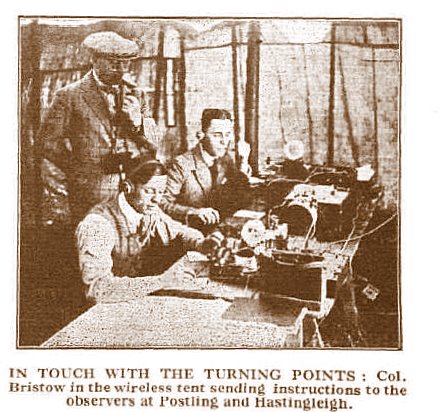
There were telegraph stations set up at
the turning points at South Hill, Hastingleigh
and Postling, which communicated with Lympne
airfield.
Reports covering these events, can be found
in the archives of Newspapers such as the
Guardian and in aviation magazines of the time.
The First Race meeting took place between the 8th and 13th of October 1923, and the joint
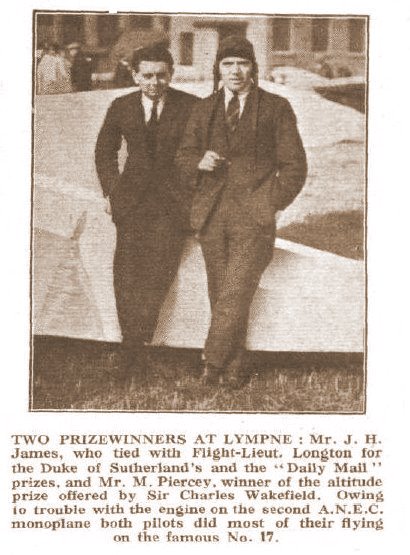
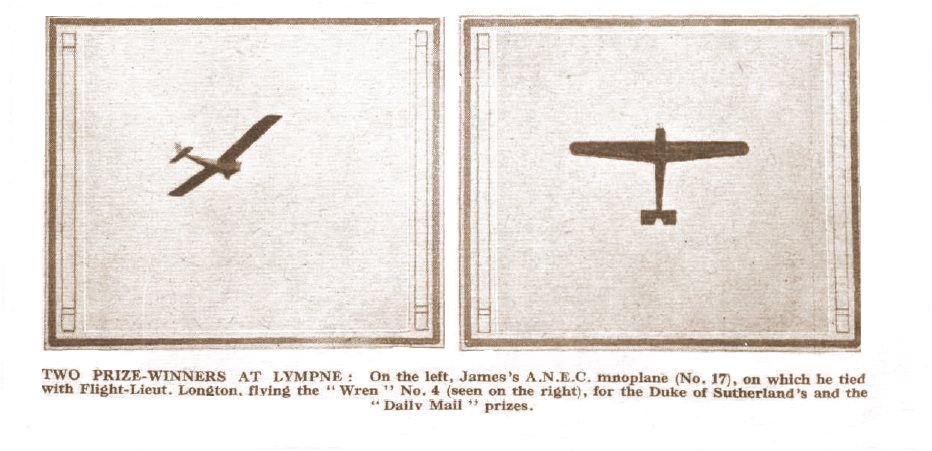
winners of the first prize went to aeroplane No 4. called 'Wren' flown by Flight Lieutenant Longton,
and aeroplane No 17. the ANEC 1 flown by Jimmy Herbert James, each managing
an amazing 87.5 miles per gallon.
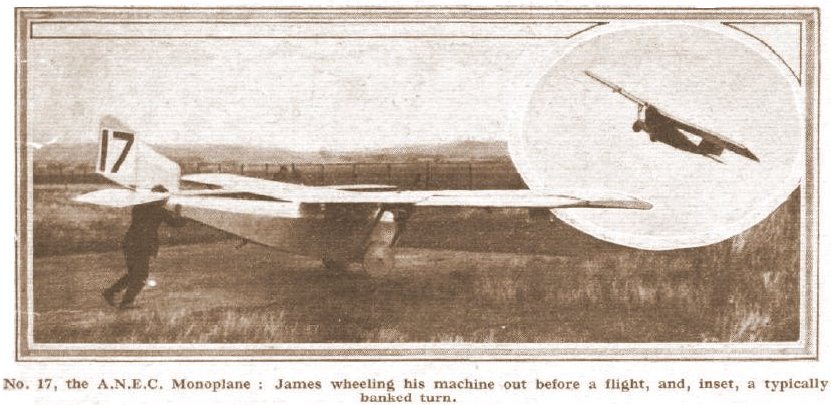
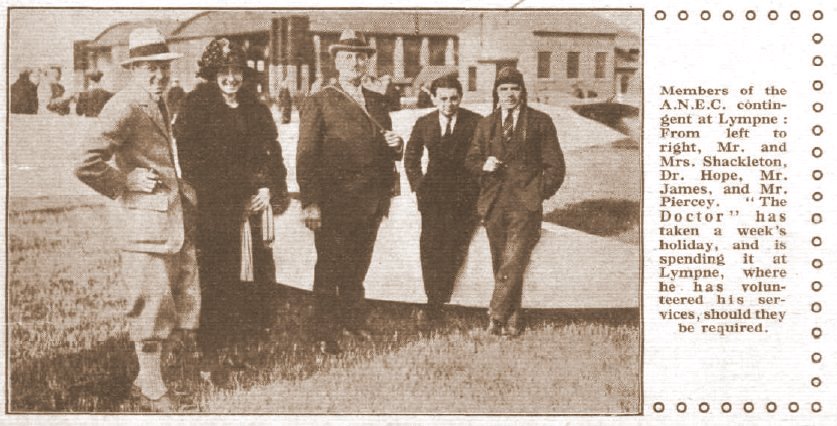
ANEC 1 was a monoplane Motor Glider, it was originally intended to be a glider and the build was commissioned by Mr Hubert Blundell, to be designed by
Mr. W.S. Shackleton. According to the great nephew of Mr Blundell who contacted this website, when the Daily Mail announced the competition for motor gliders with a 1000 pounds prize, Mr. Blundell and Mr Shackleton corresponded about altering the plans to convert the glider design in to a motor glider.The aircraft was made of wood, with a 696cc motorcycle engine (The Blackburne Tomtit), which had been modified and thus ANEC 1 was the first aircraft to fly in the United Kingdom, with an inverted engine.
Its aircraft number was G-EBHR and it was built at Addleston in Surrey by ANEC (Air Navigation and Engineering Company) and transported by road to Brooklands in Surrey where it first flew on the 21st August 1923.
[ ANEC was the new name for the Bleriot Aircraft Company, which had moved to Addleston during WW1. ]
ANEC 1 (G-EBHR) was then sold in August 1924 and shipped to Australia. There were only three ANEC 1 aircraft ever built, it was 15 ft 7 inches long, and had a wingspan of 32 feet. Two of them took part in the 1923 Races at Lympne. Entrant Numbers 17. and 18.

On 13th October 1923, Hastingleigh earned its place in Aviation and Postal history.
On the last day of the aero-race meeting, a special event was organised. The world's first Motor Glider Mail Flight.
The Duke of York (later to be King George VI) was in attendance along side many other British and Foreign dignitaries.
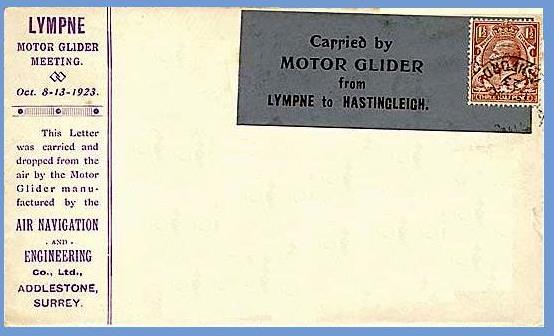
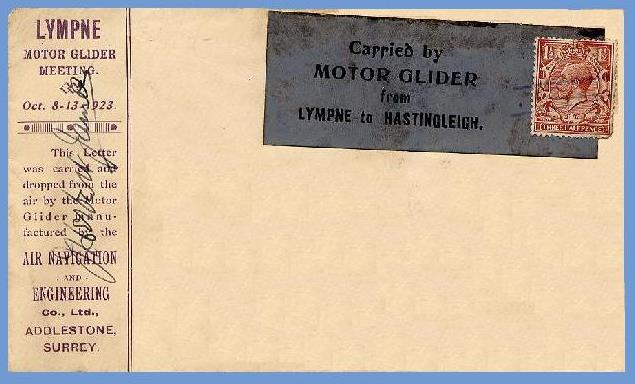
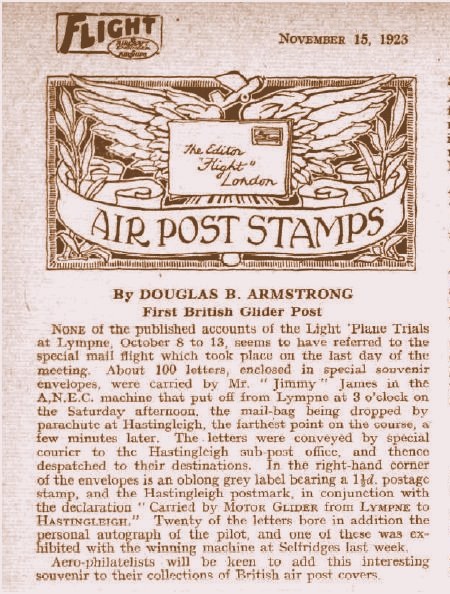
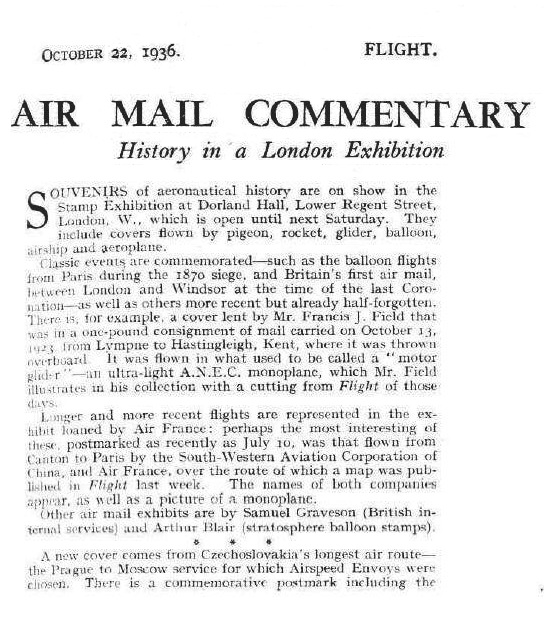
As a publicity stunt for the ANEC company, the winning aircraft ANEC 1, carried a mail bag parcel containing just over 100 special edition envelopes as it took off from Lympne at 3pm, piloted by Jimmy Herbert James. The monoplane flew up over Hastingleigh village, and Jimmy threw the package overboard to parachute to the ground. It was recovered by special courier who took the parcel up to the Post Office at Tappenden's Store; the mail was duly franked and sent on its way.
These envelopes, 20 of which were signed by the pilot (- see right hand image below) do turn up from time to time at auction, and are quite costly to acquire. They have certainly increased in value since the occasion of their first flight, when the stamp cost just a penny - ha'penny.
The same ANEC 1 aeroplane (entrant No.17) was not finished breaking records. Later that same afternoon, but with a different Pilot onboard
- a Mr. Maurice Piercey, the ANEC 1 made its dramatic attempt for the altitude record. Mr Piercey managed to get to 14,400ft to win the
greatest height competition and claim the 200 pounds prize.
To quote a report from 'Flight' magazine
"On landing, Mr Piercey, who may be assumed to have been numbed from the intense cold at the great height at which he had been flying, over shot the mark somewhat, and was still going at fairly high speed on the ground when approaching the enclosures. Captain Rogers, a representative of the British Petroleum Company, flung himself against one of the wings of the machine, thus causing it to swerve. In doing so he was winded and bruised, but he prevented the machine from running in to railings. Instead it collided with the tailplane of the deHavilland No.8, which was damaged. The wing tip of the ANEC also suffered somewhat, and a final attempt by (Jimmy Herbert) James to beat Macmillans speed figure had to be abandoned."
Sadly in the attempts to win the altitude prize, the world record breaking French pilot Alexis Maneyrol (26 Aug 1891- 23 Oct 1923) was killed when his aircraft buckled in-flight and crashed. As a result of this tragedy, the closing ceremony banquet, due to be held at Hythe, was called off as a mark of respect.
After the trials in Kent, I am informed by Mr Blundell's great nephew, that the plane was flown to Hertfordshire where it was piloted many
times by Alison Blundell, who had been a pilot in 1917 / 1918.
The demise of the aircraft came about when being piloted by Captain Bernard Arthur Smart [DSO and bar]. He crashed it in to a tree and
was quite badly injured in the crash.
Captain B.A. Smart was noted as a celebrated pilot in WW1. On the 19th July 1918 he led the second wave of Sopwith camels in a raid on the
German Zeppelin hangars at Tondern in Denmark. This was remarkable for being the first time a bombing raid had been possible from the deck
of a Royal Naval Ship:-HMS Furious. Seven Sopwith Camels sailed over to within striking distance of the Zeppelin sheds.
For the story of the Tondern raid (click here), earning his second DSO. He had only qualified as a pilot 24 July 1916 aged 24.
As a footnote: There were 276 flights over South Hill, Hastingleigh during the 5 days of flying in 1923, several of the competitor
aircraft ditched at various places between Hastingleigh and the Marshes for one reason or another. On the misty days, a number of planes
were struggling with soggy wings.
By 1926, the flights were covering much longer distances, and the Lympne - Postling - Hastingleigh - Lympne route was relegated for use in
only a small number of trials and competitions. The Lympne light aircraft rally continued for many years afterwards, and despite an interuption
for WW2, the 25th anniversary event took place in 1948. Many of historys most famous early pioneer aviators took part in these races over the years.
During the 1923 Air Races, the pilot with most flight circuits over to Hastingleigh and back, was
Bert Hinkler who managed 80 trips in 5 days winning 300 pounds for his efforts.
In August 1925, the world famous long distance aviator Sir Alan J. Cobham, brought his "Cobham's Flying Circus" to Lympne, and during one race he crashed his aircraft in Hastingleigh. You can read about the Lympne meeting and the crash on the first of the following newspaper articles. The second article dating from 1934 , mentions a pylon at Hastingleigh which was used as a pilot's visual aid for the turning point of the triangular races. This was not an electricty pylon - as electricity didn't arrive in the village till the mid 1950s, and was more likely a pylon built specifically for the races, as illustrated in the poster for Cobham's Flying Circus, shown below the second article.
The Light Aeroplane Race Meeting
Trick Act Thrills
Alan Cobham capsized but unhurt
Lympne, Monday [3rd August 1925)
By an exceedingly daring but carefully
calculated feat of trick flying, Capt F.T.
Courtney, the famous test pilot, made the
spectators gasp with horror at the third
and final day of the August race meeting
of the Royal Aero Club at Lympne to-
day.
In an interval between two races, he
took up a powerful Armstrong Whitworth
Siskin machine, and in a few minutes was
performing daring evolutions at a height
of one thousand feet or more. Then
without any warning his machine slid
into a headlong nose dive and fell almost
vertically, disappearing behind a distant
belt of trees. It seemed impossible that
such a headlong dive could have been
corrected and spectators were horror
struck.
For four or five minutes they waited
in suspense, and then Courtney appeared
flying towards the aerodrome from a
totally different direction and it became
apparent that he had only been playing
a hoax upon those who had merely asked
for thrills. After disappearing behind the
trees, it appears that he flattened out,
flew low behind a hill and finally came into
view three or four miles from the point at
which it seemed inevitable that a calamity
had befallen him.
A NARROW ESCAPE
This was not the only thrill which
attended to-day's meeting for Mr. Alan J.
Cobham, flying a D.H.60 Moth in the
final for the Open International
Handicap, over a hundred mile
sourse, and carrying a passenger
had to make a forced landing at
Hastingleigh, and came to grief in a field
of growing corn. His machine capsized
and when it came to a standstill was
lying flat upon its back. Happily how-
ever, neither the pilot nor the passenger
Mr. St. Barbe, a member of the De-Havi-
land firm, was hurt, and the machine was
practically undamaged.
"We were only a few feet from the
ground when it happened," Mr. Cobham
told a press association representative
afterwards. " I was flying about 45 to
50 miles an hour when the engine suddenly
cut out, and I had no alternative but to
land down wind. I landed fairly easily
but, running on, encountered a field of
corn. The cord held the bottom wing
and the machine slowly turned over on its
back."
Up to this point an exceedingly keen
duel for supremacy had progressed between
Cobham and Captain H.S. Broad who was
also flying a D.H. 60 Moth. As soon as he
became aware of his brother pilot's mishap,
Broad put back to the aerodrome, disem-
barked his lady passenger, and returned to
see what assistance was required.
Another piece of excitement was contri-
buted by Jimmie James, whose A.N.E.C.
light aeroplane in landing at the aero-
drome, poised itself upon its nose and the
pilot had to remain in this position until
the mechanics rushed out and extricated
him from the tiny cockpit.