contact e-mail
The Julian Calendar was in use in England before 1752.
The New Year was celebrated on 1st January as it is today,
but for offical business, the date was 25th March (also known as Lady Day.)
In the older records, if someone was born in January, February or up to 24th March,
they may have 2 years of birth. The first was the year using the Julian system, and
the second year mentioned will be using the modern Gregorian Calendar.
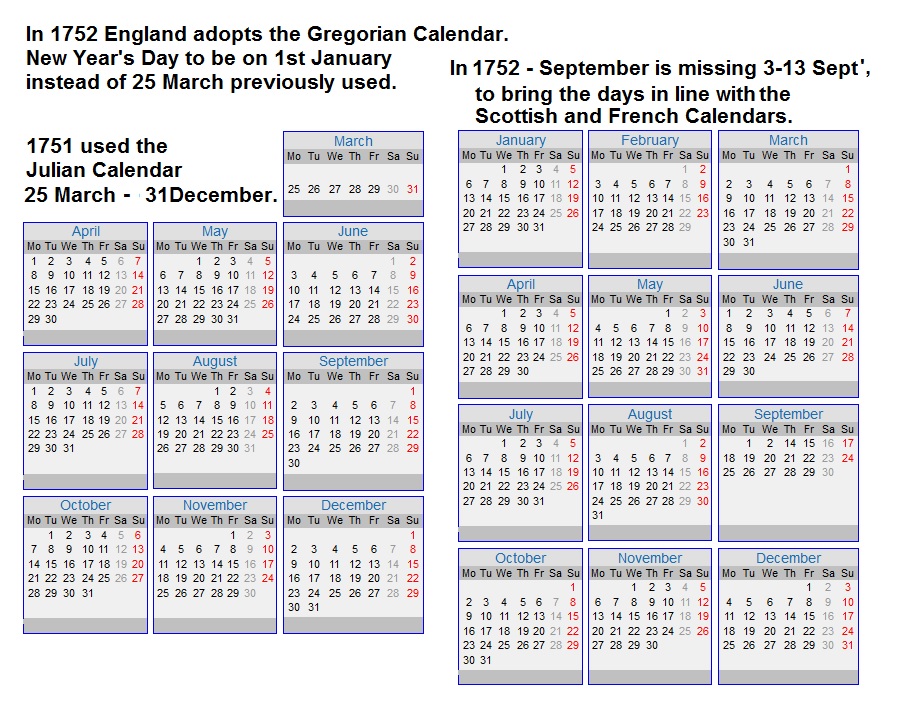
Because of the switch over to the new calendar in 1752, the year 1751 was a short year,
and only ran from 25th March 1751 to 31st December 1751.The New Year started on January 1st 1752 (The Gregorian Calendar)
There was a further adjustment in September 1752, when 11 days were taken out of the month 3rd-14th of the month were missing.
to bring the New Calendar in line with France and Scotland for example, which had already switched to the Gregorian or Modern Calendar
some years previously.
The calendars for 1751 and 1752 are illustrated below:-Because of this missing 11 days, there was civil unrest from many workers who were upset at losing 11 days pay from their annual salary.
The tax man who usually collected taxes on Lady Day, added the missing 11 days to the end of the 1752-1753 tax year, by moving the end of
the financial year back by 11 days to 6th April 1753. This remains the end of the financial year in England to this day.
Half way through the old year, from Lady Day to Lady Day, was 29 September (known as Michaelmas)
and this half way point was used by the church, to collate their records of baptisms, marriages & burials
to send to the Archdeacon at Canterbury Cathedral. So each half yearly return document will show the
events for Lady Day to Michaelmas and Michaelmas to Lady Day for the latter half of the year.
When it comes to dating Wills and Archdeacon Court documents, many show dates according to the year
of the reign of a monarch.e.g. Twentieth Five yeare of the reign of our Sovereign Lord King James of England, Ireland & France etc.
To help calculate the date, please see the Monarch's List. page for a list of dates for their reigns to help you out.
The date that the monarch ascended the throne (day, month, year) is the start of the calendar year for the purposes
of using a soverigns reign to date documents.After 1752, and the introduction of the modern calendar that we use today, if you want to know what day of the week a
particular date was, then the website www.timeanddate.com holds all the 14 possible calendars, and you can easily find the calendar applicable
for any given year.
The same website Click has a page to calculate number of days, months, years between two given dates.